On March 2, a meeting between agricultural associations and representatives of the Verkhovna Rada of Ukraine and the Government took place on the topic “European Integration. Key Challenges for Ukraine’s Agricultural Sector.” The event was initiated by the Ukrainian Agri Council (UAC).
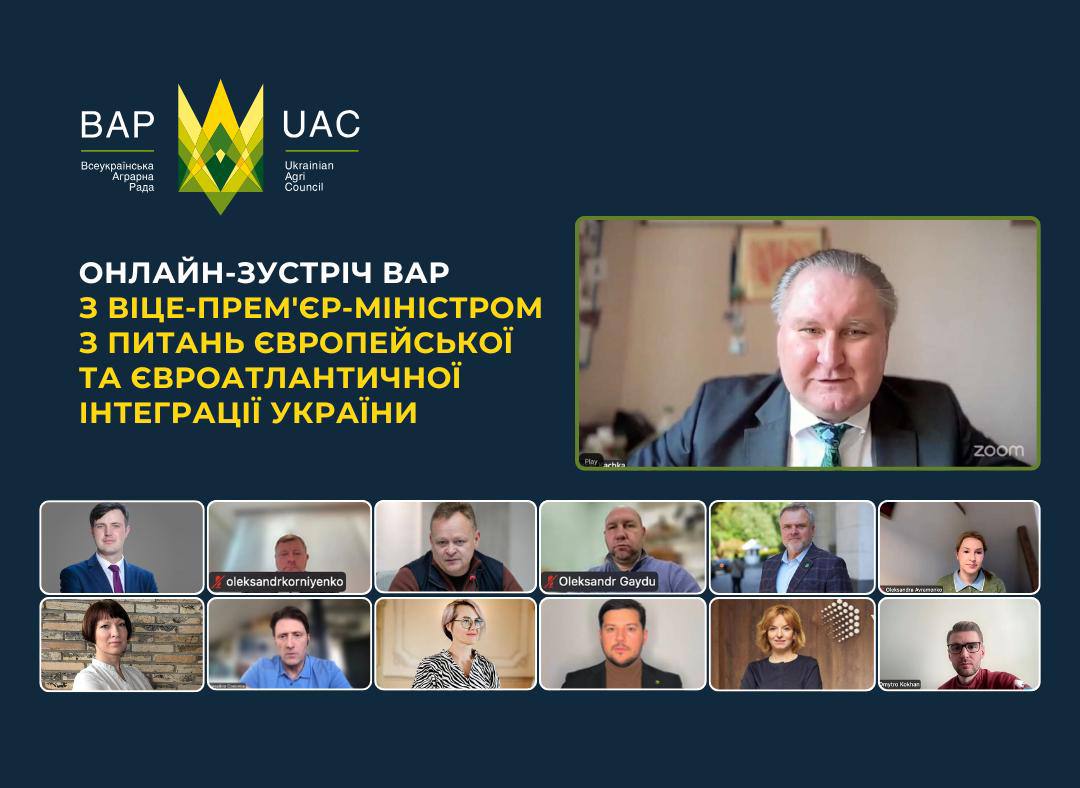
The discussion was attended by First Deputy Chairman of the Verkhovna Rada of Ukraine Oleksandr Korniienko, Vice Prime Minister for European and Euro-Atlantic Integration of Ukraine Taras Kachka, Chairman of the Verkhovna Rada Committee on Agrarian and Land Policy Oleksandr Haidu, Deputy Head of the parliamentary faction of the “Servant of the People” party Oleksandr Kovalchuk, and Deputy Minister of Economy, Environment and Agriculture of Ukraine Taras Vysotskyi.
Leading agricultural associations formed a consolidated position on the conditions of integration into the European Union. It was joined by the Ukrainian Agri Council (UAC), the Ukrainian Agribusiness Club (UCAB), the Association of Milk Producers, the Association “Pigs of Ukraine,” the Ukrainian Poultry Union, and the National Association of Sugar Producers of Ukraine “Ukrsugar.”
Industry representatives identified six key “red lines” that must be secured in the negotiation process to ensure an economically sustainable transition to EU standards.
- Transition period. The transition period, during which Ukrainian production standards and requirements must be fully harmonized with EU norms, should last at least 10 years. This primarily concerns the list of permitted active substances in plant protection products (PPP), feed additives, requirements for manure and nitrogen fertilizer application, implementation of GAEC standards, as well as the handling of animal by-products.
- Starting point from accession. The transition period must begin from the moment Ukraine joins the EU.
- Access to CAP support. Ukrainian farmers must receive access to the instruments of the Common Agricultural Policy (CAP) from the beginning of the transition period.
- Capping of support. Limitations on the amount of support per farm should not be applied to Ukrainian farmers in a way that effectively deprives a significant share of producers of support.
- Access to structural funds. The transition of Ukrainian farmers to European standards and production requirements will require substantial investments, which are unaffordable for many enterprises. Therefore, it is critically important that Ukraine’s agricultural sector, following the example of Poland and other countries from previous enlargement waves, gains access to European funding.
- Access to the EU market. Ukrainian products that fully comply with SPS and EU production standards and are marketed in EU member states in accordance with labeling, traceability, and certification requirements should receive максимально liberalized access to the EU market.
“The outlined requirements are the result of joint work by профильні associations and reflect a coordinated approach of the agricultural sector. There remain many problematic aspects for farmers — from plant protection products and feed additives to fertilizer regulation — and we must be given time to adapt. It is also important that access to support is available from the beginning of the transition period. At the same time, we are seriously concerned about possible capping of support per recipient, which for most farms will not compensate for additional costs. Therefore, we strongly urge the government to ensure that these issues are addressed during negotiations,” emphasized Mykhailo Sokolov, Deputy Chairman of the Ukrainian Agri Council (UAC).
During the discussion, participants emphasized the need for systematic communication with European partners regarding the specifics and scale of Ukraine’s agricultural sector.
“We must proceed from the fact that in accession negotiations, the initiative regarding requirements largely belongs to the European Union, as this is the logic of the negotiation process. The more we engage in explanatory work and communicate the specifics and challenges faced by Ukrainian farmers, the better the outcome will be. We are aiming for the fastest possible EU accession and must clearly understand how much time is needed to find a balance regarding the impact of subsidies and the Common Agricultural Policy on farmers’ activities,” said Vice Prime Minister Taras Kachka.
Participants thanked Oleksandr Kovalchuk for moderating and organizing the event and agreed to make such meetings regular — to be held on a monthly basis. The next meeting is scheduled for early April.
The UAC emphasizes that the agricultural sector supports Ukraine’s strategic course toward EU membership; however, integration must take place taking into account the structure of Ukrainian production, the scale of farms, and economic realities.
Friday, 6 March 2026