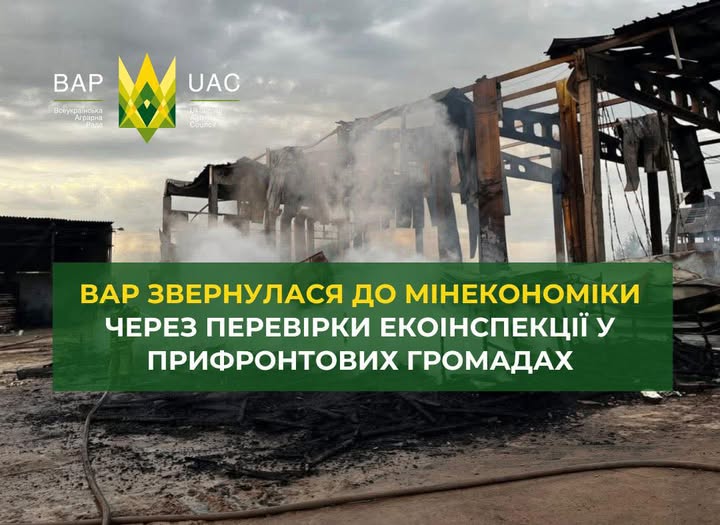
The Ukrainian Agri Council (UAC) has appealed to the Ministry of Economy, Environment and Agriculture of Ukraine regarding the practice of inspections carried out by the State Environmental Inspectorate of Ukraine (SEI) in frontline and recently de-occupied communities.
The UAC continues to receive appeals from farmers operating in areas of heightened military risk. While these enterprises continue to ensure the country’s food security, they are simultaneously receiving compliance orders requiring capital construction works, such as concrete surfacing of sites, construction of manure storage facilities, and other engineering structures.
Under wartime conditions, fulfilling such requirements is often dangerous due to ongoing shelling, guided aerial bomb (KAB) attacks, and FPV drone strikes. It is also economically risky given the high likelihood of destruction of newly built facilities and, in some cases, physically impossible due to proximity to the line of combat contact.
“Facilities constructed in close proximity to the frontline can be destroyed at any moment, which devalues the investment and does not ensure a sustainable environmental effect,” the appeal states.
The UAC also recalls that, under Cabinet of Ministers Resolution No. 303, scheduled and unscheduled state supervision measures have been suspended since March 2022 for the duration of martial law (with certain exceptions defined by law).
“Unscheduled inspections should be conducted only in cases of a real threat to the environment or to human life and health, and in accordance with a unified approach to applying Resolution No. 303,” the appeal emphasizes.
However, in practice, farmers report unscheduled inspections and the issuance of compliance orders with short implementation deadlines.
As an example, a farming enterprise in Kharkiv region received an order in 2023 requiring the construction of a solid-surfaced temporary cattle manure storage site within one month. At the time the order was issued, the frontline was approximately 38 km from the settlement, and the area was regularly subjected to shelling, making capital construction works dangerous for personnel and equipment.
Despite the enterprise’s official notification about the impossibility of completing the work within the установлен deadline due to the security situation, the supervisory authority did not adjust its approach.
In this context, farmers are calling on the Ministry to initiate an interagency resolution of the issue and to develop clear rules for frontline and de-occupied territories. In particular, they propose applying a risk-based approach, allowing for deferred compliance deadlines, permitting temporary engineering solutions, and holding a joint meeting with representatives of the Ministry, the SEI, and the agricultural community.
The Ukrainian Agri Council emphasizes that farmers are not refusing to comply with environmental standards. However, in high-risk wartime communities, a flexible approach is necessary — one that takes into account the security situation and the real operating conditions of businesses during the war.
Monday, 23 February 2026