The Ukrainian Agri Council (UAC), together with the Ukrainian Agribusiness Club (UCAB), has appealed to the Ministry of Economy, Environment and Agriculture of Ukraine with a request to urgently allow the import of calcium ammonium nitrate (CAN) through seaports. The appeal comes amid a sharp deterioration in the supply of nitrogen fertilizers ahead of the spring sowing campaign.
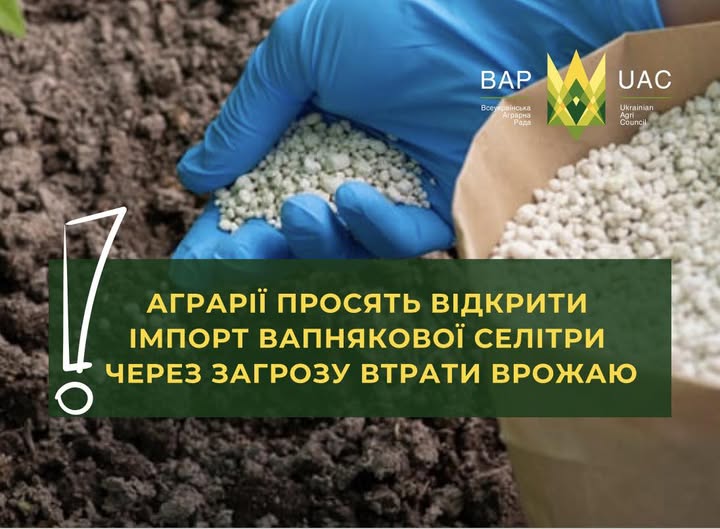
Industry associations recall that following russian attacks on port infrastructure, a ban was introduced on the transshipment, storage, and transportation of certain cargoes, including ammonia and calcium ammonium nitrate.
At the same time, agricultural associations emphasize that the inclusion of CAN in the list of explosive materials has no scientific justification.
“No explanation has been provided regarding the documents or research on the basis of which calcium ammonium nitrate was classified as explosive,” the appeal states.
According to the associations, international and national standards indicate otherwise.
“Under the UN Model Regulations, calcium ammonium nitrate is classified under UN 2071, which refers to non-explosive substances. Grades A and B with a nitrogen content of no more than 28% are non-combustible and do not pose fire or explosion risks,” the associations noted.
Due to the current ban and a simultaneous decline in domestic production, the market is already facing shortages. As of February 2026, the deficit of nitrate fertilizers is estimated at 100,000–170,000 tons. Domestic production of ammonium nitrate in Ukraine has nearly halved — from 1.99 million tons in 2024–2025 to 1.016 million tons in the 2025–2026 season, due to infrastructure attacks and electricity supply disruptions.
The UAC and UCAB warn that the consequences could be systemic for the entire economy.
“A reduction in total crop yields due to nitrogen shortages could reach 20%,” the document emphasizes.
Approximately half of Ukraine’s agricultural soils allow ammonium nitrate to be replaced with calcium ammonium nitrate. However, farmers currently have virtually no access to this fertilizer.
The associations state that they support security measures under wartime conditions but propose introducing controlled imports under clearly defined safety parameters.
In particular, they propose allowing imports through Danube ports with a safety data sheet for products containing up to 80% ammonium nitrate (nitrogen content up to 27.52%), and through Black Sea ports with up to 70% ammonium nitrate content (nitrogen content up to 24.08%).
“We hope for continued constructive cooperation to support the development of Ukrainian agribusiness,” the authors of the appeal stated.
A prompt decision is critically important ahead of the spring sowing campaign, as the availability of nitrogen fertilizers directly affects crop yields, export stability, and Ukraine’s food security.
Monday, 16 February 2026