The Ukrainian Agri Council (UAC) held a webinar for farmers dedicated to the procedure for obtaining the status of a critically important enterprise and reserving employees under martial law.
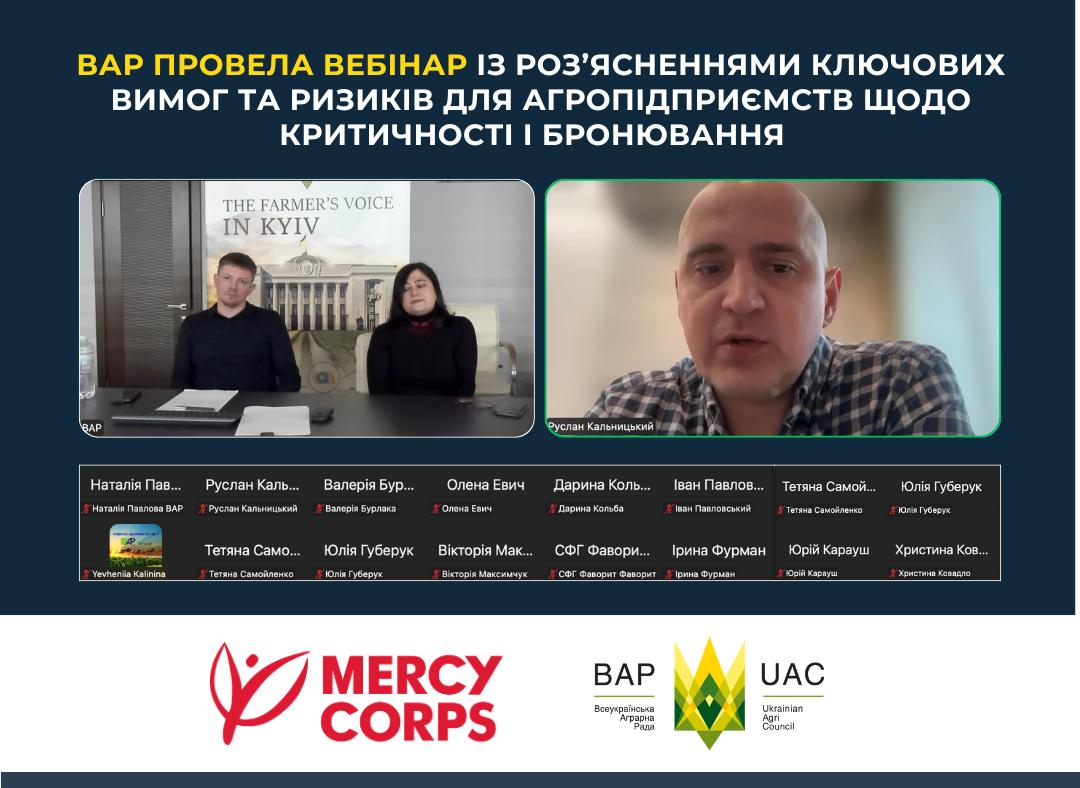
More than 200 agricultural enterprises received answers to key questions, including explanations of how the status of the ultimate beneficial owner is determined and regulated in the context of employee reservation, how to properly prepare a company’s land bank before obtaining critically important status, as well as a detailed overview of the procedure and criteria for obtaining such status for agricultural enterprises in accordance with Resolution No. 76.
Lesia Pankratova, UAC consultant on accounting and taxation, noted that one of the key criteria for obtaining critical status is the level of the average salary — it must be no less than 2.5 minimum wages (currently over UAH 21,600). The verification of this data is carried out automatically through data exchange with the Pension Fund, and any discrepancy may result in the loss of status.
The expert also explained that when calculating the average salary, not only wages but also sick leave payments and temporary disability benefits are taken into account. At the same time, it is important to correctly determine the number of employees, as even part-time workers or those with secondary employment are counted as full units, which directly affects the calculation result.
Serhii Ulchenko, UAC legal consultant, emphasized that a significant share of refusals to grant critical status is related to unregulated land relations. In particular, all land plots cultivated by the enterprise must be formalized through agreements (lease, sublease, or emphyteusis) and registered in the state register, as these data determine the actual land bank of the enterprise.
Another important aspect is monitoring compliance after obtaining critical status. The state conducts monthly monitoring of enterprises, and in case of non-compliance, the status may be revoked, with reapplication allowed only after six months.
A separate part of the webinar was dedicated to ultimate beneficial owners. In particular, the importance of timely updating information on UBOs was emphasized: failure to submit or late submission may result in fines — up to UAH 51,000 for officials and up to UAH 340,000 for legal entities.
Ruslan Kalnytskyi, Project Manager of the UAC legal advisory hotline, added that UAC experts have prepared an analytical digest based on their presentations, which contains answers to most of the questions raised by webinar participants, as well as step-by-step recommendations for agricultural producers.
The webinar was held within the framework of the UAC project to support Ukrainian agricultural producers from affected regions in partnership with the international humanitarian organization Mercy Corps and became part of a series of webinars aimed at informing farmers and improving the efficiency of agricultural enterprises.
You can access the digest via the link: https://drive.google.com/file/d/1II4l0Y7XYGdDGy4ySt3-fagljDZWu87M/view?usp=drive_link
For additional questions and to receive legal and accounting consultations, please contact the legal advisory hotline for agricultural producers from affected territories: +38 067 522-03-43
About Mercy Corps:
Mercy Corps is an international humanitarian organization operating in more than 40 countries worldwide, providing assistance to people affected by disasters, wars, poverty, and the consequences of climate change.
Friday, 20 March 2026