How the official monetary valuation of land diverged from reality in southern Ukraine.
Every time agricultural land is leased or sold in Ukraine, one figure stands in the shadow of the transaction — the normative monetary valuation (NMV). It determines the minimum rent, land tax, and a number of other state calculations. NMV does not directly define the market price of land, but it sets the framework within which the entire agricultural sector operates.
The NMV methodology was built on a simple assumption: more productive land → higher valuation → greater obligations. The logic is sound. But what happens when reality and valuation diverge — and do so systematically over an entire decade?
Odesa region, according to normative monetary valuation, is positioned above the national average. Its NMV index is 110.2%. Meanwhile, the real economic return per hectare looks fundamentally different. In 2022–2024, actual agricultural productivity in Odesa region amounted to only 65.7% of the national average.
This is not a statistical error or solely the effect of war. Zaporizhzhia, Mykolaiv, and Kherson regions show a similar pattern. Data for 2015–2024 indicate that all four southern regions consistently rank among those with the lowest agricultural return per hectare in Ukraine. The ranking remains almost unchanged throughout the entire period.
The question that arises from these data is simple: if land consistently yields less than what the normative valuation assumes — who pays the difference, and for what?
What AHP Measures and Why It Matters
To compare normative valuation with reality, a metric is needed that speaks in terms of facts rather than expectations. Such a tool is the agricultural productivity per hectare indicator (AHP).
AHP shows how many hryvnias of gross crop production are actually generated by one hectare of sown area in a region per year. It is based on data from the State Statistics Service: sown areas, crop yields for each crop, and prices. All calculations are made in constant prices to eliminate inflation distortions and ensure comparability across years. AHP covers the entire production portfolio — cereals, oilseeds, legumes, and industrial crops — and all categories of farms, from large companies to small farmers. The denominator of the formula is sown area, excluding uncultivated and mined land. In wartime conditions, this is critically important.
AHP and NMV have different natures: the former measures actual output, the latter — capitalized expected income. Therefore, it is correct to compare not absolute values, but relative positions — how much a region deviates from the national average under each indicator. If NMV adequately reflects productivity, the indices should be close. If there is a large gap, it signals a systemic problem.
Three Reasons Why the South Produces Less
The gap between normative valuation and actual productivity in the four southern regions is not случайність and not the result of a single bad year. It is driven by three interrelated factors, each supported by a decade of data.
Climate roulette: between yield and catastrophe
The steppe zone is not just a dry region. It is a zone where the amplitude between a good and a crisis year reaches 40–70% of the average productivity level.
Over ten years of observations, each of the four regions experienced at least three to four crisis years with AHP declines of 15–45%. The drought of 2020 was the absolute minimum: AHP in Odesa region fell to UAH 14.0 thousand/ha, compared to a national average of about UAH 29.0 thousand/ha in the same year.
The NMV methodology assumes stable capitalization of rental income. But in a region where real income fluctuates with an amplitude of 40–70% from peak to bottom, the notion of “stable capitalization” is more of a theoretical construct than a reflection of reality. No other macro-zone in Ukraine demonstrates such instability.
Baseline level: even in good years — lower
Climate volatility explains crisis years. But even when weather conditions are favorable, southern regions consistently lag behind the rest of the country in yields of key crops.
Wheat — the core of the region’s production portfolio, accounting for 35–45% of sown area — shows yields 15–31% below the national average in 2022–2024. Sunflower — the second most important crop for the region, despite deeper roots and higher drought resistance — shows a similar pattern, with deviations of 21–47% below the average.
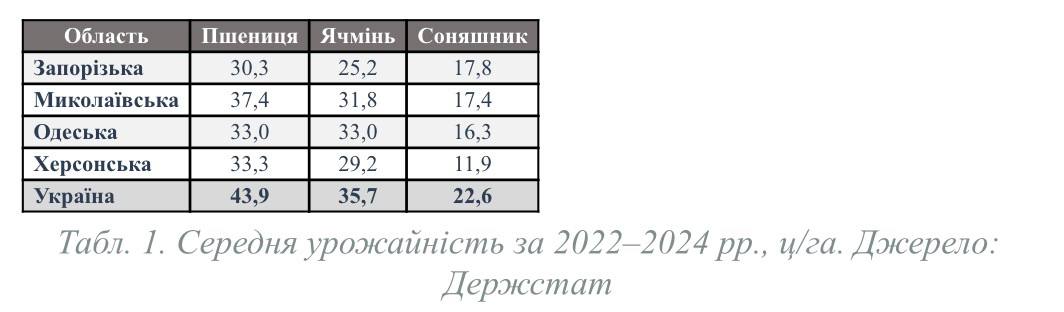
The reason lies in objective natural and climatic constraints: moisture deficit during critical vegetation phases, dry winds during flowering, and the effective absence of irrigation. This is not a temporary issue of insufficient investment or weak agronomy. It is a structural limit that the NMV methodology insufficiently accounts for.
War: an amplifier, not the cause
The full-scale invasion did not create the regional gap — it intensified it to a point where it can no longer be ignored.
Before 2021, Kherson region was the closest to the national average among the “southern four”: its AHP index was 98.8% in the pre-war period. After 2022 — 63.8%, a drop of 35 percentage points. The destruction of the Kakhovka HPP in June 2023 eliminated irrigation infrastructure that had for decades compensated for the region’s climatic constraints. The occupation of left-bank areas, flooding of arable land, and mined fields represent irreversible losses of productive potential.
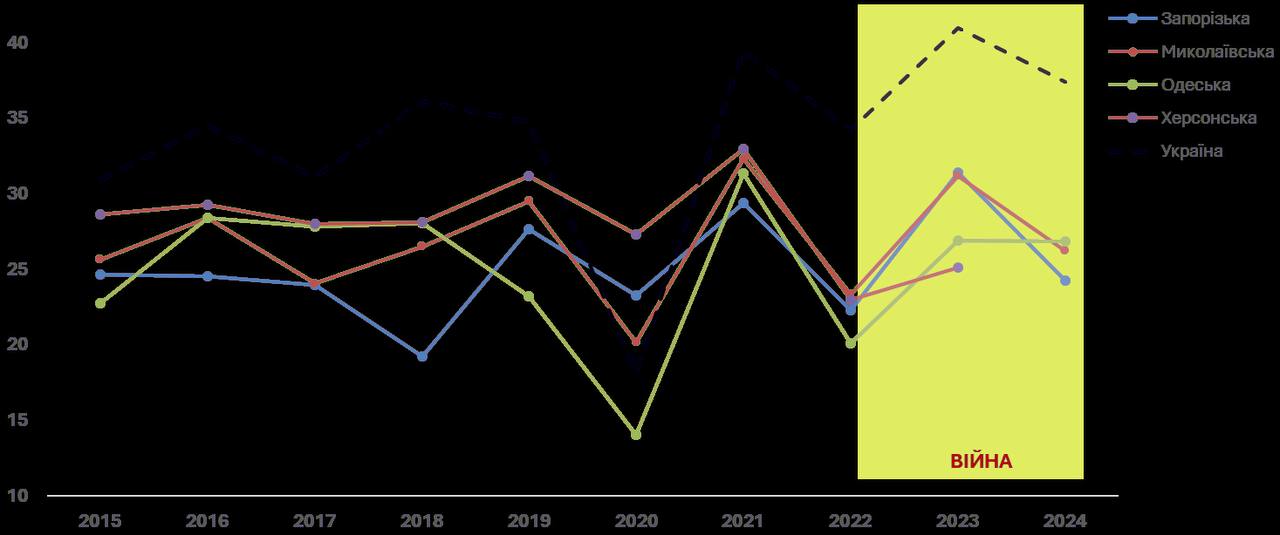
Fig. 1. AHP dynamics: four southern regions vs national average (2015–2024), thousand UAH
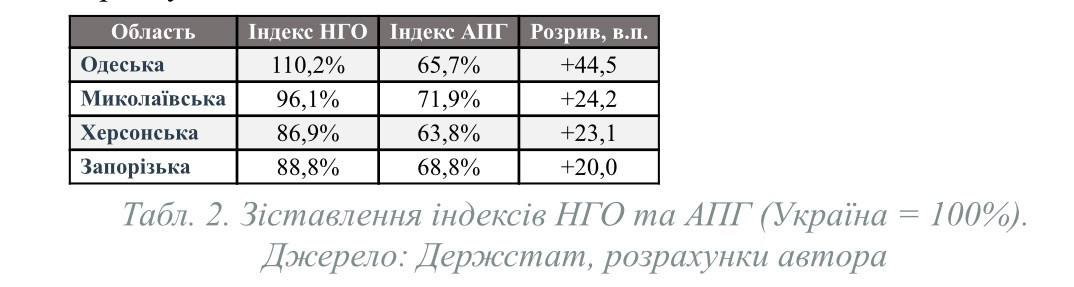
Odesa region is the most striking case. NMV positions it above the national average, while actual returns are about one-third lower. Land users pay obligations calculated based on a valuation that is 1.7 times higher than the real economic return of the land. For Mykolaiv, Kherson, and Zaporizhzhia regions, the gap is smaller, but twenty percentage points is not a technical error that can be ignored. It is a systematic distortion of operating conditions, reproduced year after year.
A Framework That Requires Reset
Regional differences in agricultural productivity are a natural reality in any large country. Poland, France, and Brazil all live with them. The question is not whether the gap exists. The question is whether state economic instruments account for it — or, on the contrary, reinforce and deepen it.
In its current form, normative monetary valuation does the latter for the four southern regions. A system designed to reflect real land productivity instead fixes inflated expectations for regions with objectively more challenging conditions: climatic, infrastructural, and wartime. The result is that land users bear financial obligations that do not correspond to actual returns, while investors receive distorted signals about the value of land assets.
Ten years of data leave no room for another interpretation: this is not a cyclical anomaly that will resolve itself. It is a structural gap between normative and actual reality. It existed before the war, intensified during the war, and will persist after it — unless the valuation methodology is aligned with what is actually happening in the fields.
Methodological Note
AHP is calculated based on data from the State Statistics Service of Ukraine (gross crop production in constant 2021 prices, sown areas by category). NMV — as of 2024. Analysis period: 2015–2024, with three base periods (2015–2017, 2019–2021, 2022–2024). The full AHP calculation methodology and data sources are presented in the study “Agricultural Productivity per Hectare: Regional Analysis.”
Monday, 9 March 2026